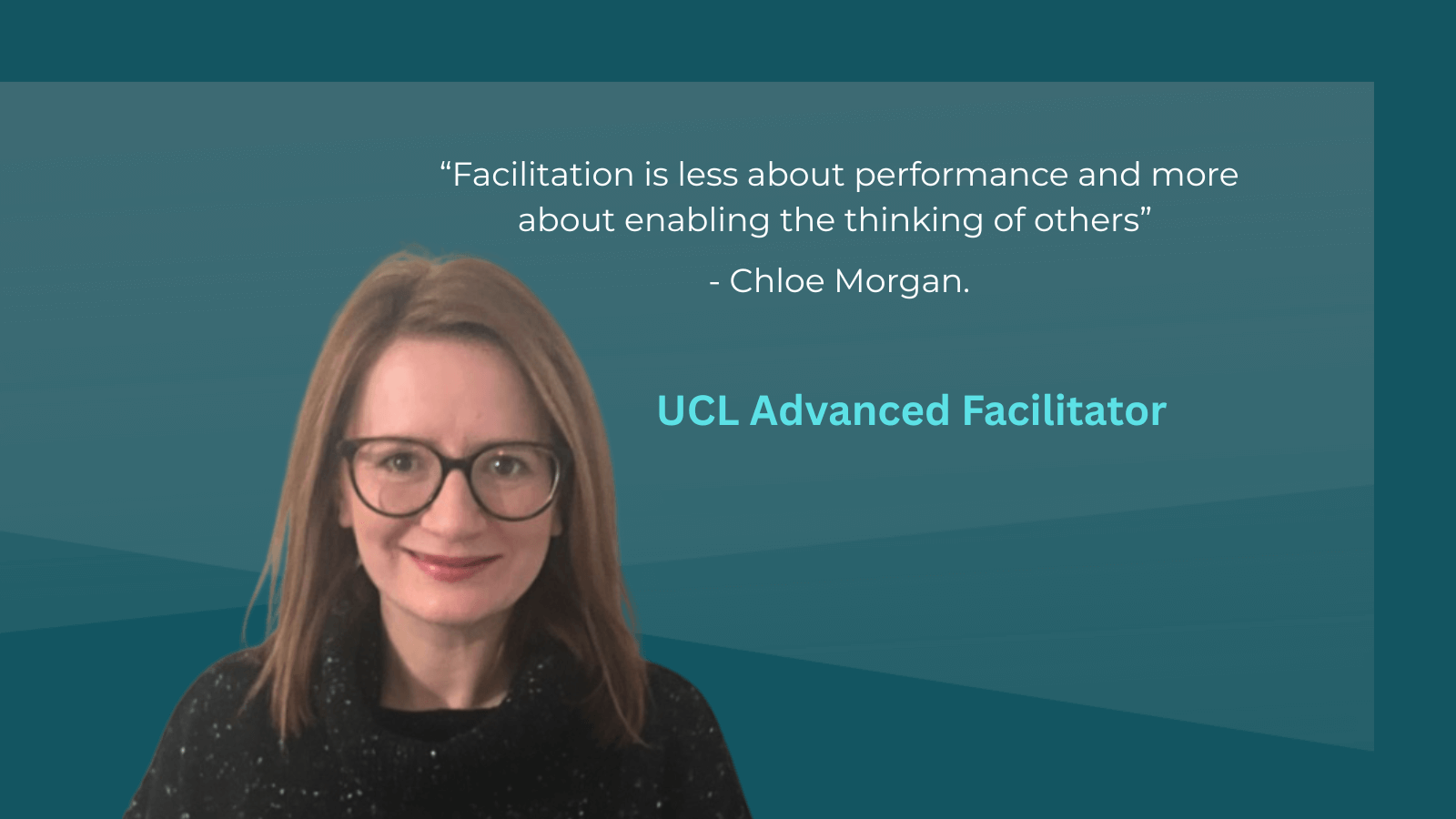
UCL Advanced Facilitator Recognition – Chloe Morgan Shares Insights and Reflections
We are incredibly proud to share that our facilitator, Chloe Morgan, has successfully completed the advanced facilitator unit with University College London (UCL)!
This prestigious recognition highlights her amazing impact on facilitation practice, her strong commitment to her profession, and genuine passion for helping others grow and succeed.
Among the fantastic group of facilitators at Wandle Teaching School Hub, Chloe has built a reputation for designing and delivering engaging ECT sessions that are not only highly informative, but truly inspiring and challenging.
Successfully completing the advanced facilitator training with UCL is a rigorous process. Chloe was visited twice, she had to submit written reflections and her practice was critically examined from planning to delivery and then post-delivery reflection.
Chloe Morgan began her career as a Secondary English teacher, before working as Head of Department and then leading whole-school teaching and learning and school-based Initial Teacher Training. Her work has since shifted to the university side of teacher training, and she now works as a University Lead Mentor and Visiting Assessor. Alongside this, she facilitates on the ECTE programme and acts as the Secondary Lead Facilitator for Wandle Teaching School Hub.
We asked Chloe to reflect on her approach to facilitation and share the values that shaped her practice.
What motivated you to pursue a career as a facilitator?
When facilitation is done well, it supports people to connect research with their own school context, to think more deeply, and to feel more confident about the decisions they make day to day in the classroom. I hope that training sessions feel both supportive and challenging, and that sessions prompt Early Career Teachers to question their assumptions and continually reflect upon their practice.
What do you believe are the key qualities of an effective facilitator?
I think the ability to balance warmth with challenge is particularly important. As a facilitator, you aim to create a safe space where assumptions and ideas can be explored and challenged respectfully. Effective facilitators pass the learning over to the teachers in the room and give them the time and opportunity to reflect upon their practice. I think effective facilitators guide and strengthen this process.
How would you describe your overall approach or philosophy to facilitation?
My approach is rooted in careful planning and responsive facilitation. I want participants to leave sessions feeling clearer in their thinking and able to translate ideas into their own schools. I try to ensure that professional learning remains closely connected to the reality of classroom practice, while still creating opportunities for deeper reflection. I place a strong emphasis on dialogue: building in structured time for participants to think, discuss, and challenge ideas respectfully. For me, the facilitator’s role is to notice what is happening in the room and use questioning to help participants to refine their thinking over time.
Can you share a key experience of a particularly impactful experience that contributed to your achievement?
A recent Module 3 session on curriculum design stands out for me. We explored a seemingly simple question: “What are we ultimately teaching for?” Our Early Career Teachers then considered whether the curriculum should prioritise academic outcomes, social and emotional development, or a combination of both. What made the session impactful was the depth of the discussion. Participants justified their views, challenged one another respectfully, and uncovered assumptions beneath their thinking. By the end of the session, several ECTs reflected on how their thinking had changed over time and were able to pinpoint the experiences that had shaped their views.
What advice would you give colleagues who are looking to grow and develop their facilitation practice?
My advice would be to create space for thinking and resist the urge to interrupt or over-explain. Facilitation is less about performance and more about enabling the thinking of others.
What common challenges do facilitators face and how would you typically navigate them?
One common challenge I have faced myself many times is balancing the voices in the room. Leading training sessions is very similar to classroom teaching: in large groups, some voices tend to dominate and others can go unheard. Dialogue needs to be structured carefully so that all participants can share their ideas and shape their thinking. I often use routines that provide thinking time first, followed by paired or small-group discussion before wider sharing. Another common challenge is pacing, especially knowing when to slow down certain tasks. I have found that taking time gives ECTs the space to explore a topic in greater depth, which often leads to more meaningful learning.
What support or resources do you find most helpful during your work?
My greatest resource is other facilitators. We work as a team in planning meetings and reflect upon the learning from each facilitated session. When someone brings a question about how to adapt content for a particular group, there is always a wealth of ideas and practical suggestions shared across the group. Facilitators know their ECTs extremely well and have a deep understanding of the school contexts they are working within. Working with colleagues who are committed to making professional development both impactful and relevant is genuinely inspiring. I also find returning to the UCL Facilitator Coaching Framework helpful when reflecting on my practice, because it provides a clear structure for analysing what is happening in the room and identifying areas for growth.
Is there anything else you would like your readers to know about your journey?
Successfully passing the UCL Advanced Facilitator course, which included observation and reflective evaluation of my practice, has been really rewarding. It was a challenging course, but also hugely developmental and practical. It gave me the opportunity to think carefully about the decisions I make as a facilitator and to refine my approach in a more intentional way. I am delighted to have achieved it, and it has been especially useful to apply that learning directly to my role. At the same time, it reinforced that facilitation is always evolving and there is always something new to learn.
A big ‘thank you’ to Chloe for sharing her valuable insights and thoughtful answers with our readers.
We are pleased that facilitators get the recognition they deserve.
Become an ECT or NPQ Facilitator at WTSH
